Introduction
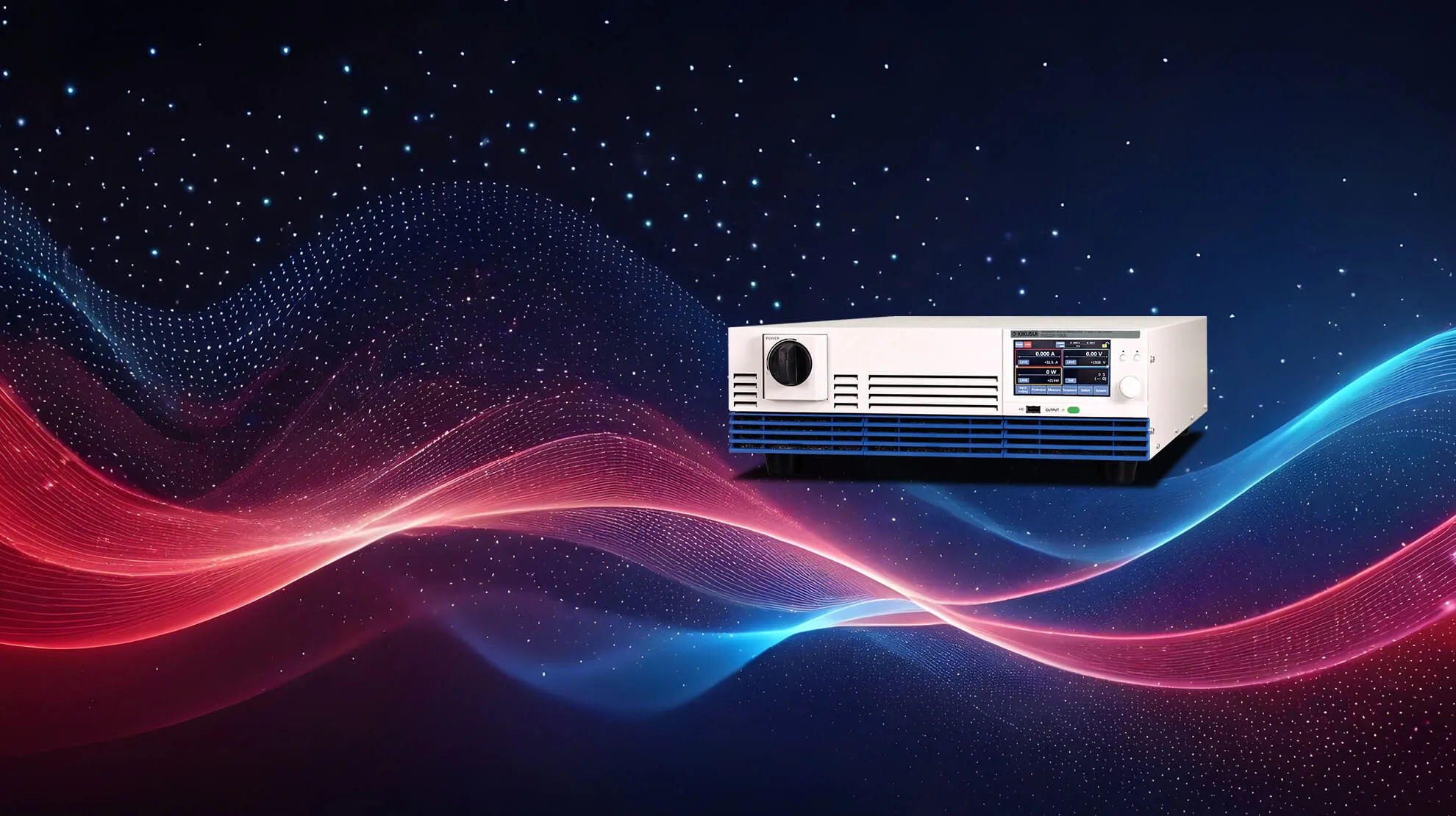
A DC electronic load is one of the most fundamental instruments in electronics engineering, acting as the necessary counterpart to the DC power supply. Whether you are designing power converters, validating battery packs, or characterizing fuel cells, a reliable “Sink” to absorb current is essential. Unlike passive resistors or light bulbs, which provide static and uncontrollable loading, a programmable DC electronic load offers precise current control and dynamic simulation, enabling engineers to replicate real-world stress conditions safely and accurately.
In this guide, we will explore DC electronic loads in depth—from basic principles to advanced architectures—while highlighting how Kikusui America’s solutions meet the needs of modern engineering applications.
Session 1: Understanding DC Electronic Loads
While a power supply pushes energy into a system (“Source”), an electronic load absorbs energy from it (“Sink”). Most electronic devices, including batteries, renewable energy sources, and power supply units (PSUs), require rigorous testing under load to verify their performance.
1. Why DC Electronic Loads Are Necessary
Although sliding rheostats (variable resistors) can serve as basic loads, they lack the precision and flexibility required in laboratory and industrial environments. A regulated DC electronic load allows engineers to:
- Set exact current, voltage, and power levels independent of source fluctuations.
- Maintain Constant Current (CC) even as battery voltage drops—something impossible with simple resistors (I=V/R).
- Simulate dynamic operating conditions, such as a CPU waking from sleep in microseconds or an EV inverter switching states.
- Protect devices under test (DUT) with built-in safety features like Over Power Protection (OPP) and Over Current Protection (OCP).
- Automate test sequences for efficiency and repeatability via PC control.
2. How Does a DC Electronic Load Work?
A DC electronic load controls the current drawn from a power source.
The method of control depends on the type of electronic load, primarily whether it is a linear type or a regenerative type.
Linear Type (Dissipating Input Power as Heat):
In a linear electronic load, power transistors such as MOSFETs or IGBTs are operated in their linear region according to the programmed setpoint.
All of the input power is dissipated as heat within these power transistors, and the generated heat is released to the surrounding environment through heatsinks and cooling fans.
Regenerative Type (Returning Input Power to the Grid as AC Energy):
In a regenerative electronic load, current is drawn into the load from the source in accordance with the setpoint.
The absorbed power is then boosted and transferred through an isolated converter to the primary side.
Subsequently, an inverter on the primary side generates AC voltage synchronized with the utility grid, allowing the absorbed load power to be regenerated back to the grid.
While there are differences in the speed of current control depending on the operating principle, both linear and regenerative electronic loads are capable of emulating impedance behaviors that cannot be reproduced using passive components alone.
This “active” nature allows the instrument to mimic complex impedance behaviors that passive components cannot.
3. Key Specifications Every Engineer Should Know
When selecting a DC electronic load, understanding its specifications is critical:
- Operating Area (SOA): Defines the safe voltage-current combinations. A 1000 W load cannot necessarily draw 1000 W at its minimum voltage limit.
- Slew Rate (A/µs): Determines how fast the load can change current (Transient Response). High slew rates are vital for testing server PSUs.
- Minimum Operating Voltage: The lowest voltage at which the load can still draw full current. Critical for fuel cells and single-cell batteries.
- Input Rating: Expressed in Watts, Volts, and Amps.
- Communication Interfaces: LAN (LXI), USB, RS232C, or GPIB for automation.
Session 2: Types of DC Electronic Loads
When engineers begin exploring DC electronic loads, one of the first distinctions they encounter is the difference in architecture and functionality. Understanding these types is crucial because the choice of load directly impacts test accuracy, efficiency, and facility requirements (HVAC/Electricity).
Linear (Heat Dissipation) Loads
Linear electronic loads are the traditional design, known for their speed and precision. They operate by using power transistors in their linear region to act as variable resistors, converting absorbed electrical energy entirely into heat.
The primary advantage of linear loads (like the PLZ-5W Series) is their extremely fast response and low electrical noise, making them ideal for testing switching power supply transients and sensitive analog circuits. However, this comes at a cost: they generate significant heat, requiring robust air conditioning in the lab for high-power applications.
Regenerative Loads
Regenerative electronic loads have become the industry standard for high-power and continuous testing applications. Instead of dissipating energy as heat, they use highly efficient inverters to convert DC energy back into AC and return it to the facility grid.
The benefits are clear: regenerative loads (like the PXZ Series) are highly efficient—often recycling approx. 90% of energy. This drastically reduces electricity bills and eliminates the need for massive HVAC systems. They are essential for battery cycling and burn-in testing where tests run 24/7. The trade-off is typically a slightly slower transient response compared to linear designs.
Modular and Multi-Channel Designs
Today’s engineering workflows demand flexibility. Modular DC electronic loads (like the PLZ-U Series) allow engineers to mix and match different load modules (e.g., 75 W and 150 W) into a single mainframe. This is perfect for testing multi-output power supplies or simultaneous cell testing in a compact footprint.
Why This Matters
Choosing between linear and regenerative is not just a technical decision—it affects operational costs (OPEX) and test capability. For example, a lab focused on server PSU transient response will prioritize the speed of a linear load, while a gigafactory performing battery endurance tests will require the energy savings of a regenerative system.
Session 3: Advanced Features for Modern Testing
Modern DC electronic loads are far more than simple current sinks. They have evolved into sophisticated instruments that enable engineers to replicate complex real-world conditions. Understanding these advanced features is essential for anyone working in R&D or validation.
Operating Modes (CC, CV, CR, CP, ARB)
Beyond simple current draw, advanced loads support multiple modes:
- Constant Current (CC): For battery discharging and load regulation.
- Constant Voltage (CV): Simulates a battery to test chargers (OBC).
- Constant Resistance (CR): Simulates passive loads to test startup behavior.
- Constant Power (CP): Simulates DC-DC converters to stress power supply stability.
- Arbitrary I-V (ARB): Allows users to plot specific V-I points to simulate non-linear devices like LEDs.
0 V Input & Low Voltage Operation
Standard loads often stop working below 3 V because their internal circuits need headroom. However, testing fuel cells or single-cell batteries requires operation near zero.
- Low Voltage: Kikusui’s PLZ-5W operates down to 0.25 V (at reduced current), sufficient for most DC-DC converters.
- True 0 V: The PLZ-U (PLZ-70UA) features an internal bias supply to enable true 0 V operation, ensuring accurate I-V characterization right down to short-circuit conditions.
High-Speed Switching (Dynamic Mode)
To validate the stability of a power supply, engineers must stress it with rapid load changes. The Dynamic Mode allows the load to switch between two current levels at high frequencies (up to 100 kHz for PLZ-5W). This reveals the “Transient Recovery Time” and checks for voltage undershoot/overshoot that could crash a system.
Sequence Control
In many test scenarios, engineers need to apply a complex profile of load changes over time. Sequence control allows these to be programmed automatically. For example, simulating an EV Drive Cycle (accelerate, cruise, brake) to test battery thermal management.
Remote Sensing
Just like power supplies, voltage drops across cables can ruin a test. Remote sensing uses separate lines to measure voltage at the DUT terminals, ensuring the load regulates based on the actual device voltage, not the input terminal voltage.
Why These Features Matter
For beginner engineers, these capabilities might seem advanced, but they are what differentiate a basic load from a professional-grade instrument. Features like Slew Rate (speed) and 0 V Input ensure you can test modern, low-voltage, high-speed electronics without false passes or failures.
Session 4: Kikusui’s Product Lineup and Technical Advantages
Kikusui America offers a diverse range of DC electronic loads designed to meet the needs of modern engineering—from benchtop R&D to high-power industrial testing. Each series addresses specific challenges, combining precision, flexibility, and advanced features.
PLZ-5W Series – High-Speed Multifunctional DC Electronic Load
The PLZ-5W Series is Kikusui’s flagship linear solution for engineers who need versatility and precision.
- Operating Range: 0.25 V to 150 V.
- Fast Transient Response: Industry-leading 4 µs rise time.
- Advanced Control: ARB (Arbitrary I-V) mode, Soft Start, and Color LCD.
- Connectivity: LAN (LXI), USB, RS232C standard.
- PLZ-5WZ Series (Impedance Measurement): Features a built-in impedance measurement function, allowing engineers to analyze the internal resistance (ESR) of batteries and fuel cells without external analyzers.
- PLZ-5W SR Series (Smart Rack): A turnkey high-power solution delivering up to 20 kW in a dedicated rack, pre-wired for immediate use in large-scale automotive and industrial testing.
- Best For: Switching power supply validation, server/AI power rails, and precise automotive component testing.
PLZ-5WH2 Series – High-Voltage High-Power DC Electronic Load
Designed for the era of electrification, the PLZ-5WH2 offers immense power and voltage handling.
- High Voltage: 10 V to 1000 V (Min. operating voltage 1.5 V) to cover 800 V EV architectures.
- High Power Density: 20 kW in a compact 13U size.
- Ultimate Scalability: Supports Master-Slave parallel operation with flexible combinations. You can connect multiple units of different power ratings to scale up to 100 kW+, providing unmatched flexibility as your testing needs grow.
- Best For: EV battery packs, high-voltage DC-DC converters, and OBC sink-side validation
PXZ Series – Regenerative DC Electronic Load
The PXZ Series represents Kikusui’s cutting-edge technology for energy-efficient testing.
- Architecture: Regenerative (Recycles energy to the grid).
- Efficiency: Approx. 90% regeneration efficiency.
- Power: 20 kW in 3U, up to 25 units (500 kW) can be operated in parallel.
- Voltage: Models available up to 1500 V.
- Best For: Battery cycling, aging/burn-in tests, and high-power inverter testing where OPEX reduction is critical.
PLZ-U Series – Modular Multi-Channel Load
For production lines and multi-rail testing, the PLZ-U Series offers compactness and flexibility.
- Modular: Mix 75 W and 150 W modules in a 3-slot or 5-slot frame.
- 0 V Input: The PLZ-70UA module operates at true 0 V.
- Best For: Fuel cell stacks (single cell), multi-output PC power supply inspection.
Why This Lineup Matters
Kikusui’s portfolio covers every engineering need—from the microsecond-level precision of the PLZ-5W to the megawatt-scale energy efficiency of the PXZ. This allows engineers to scale their testing capability seamlessly from the benchtop to the factory floor.
Session 5: Application Scenarios and Best Practices
DC electronic loads are indispensable validation tools across a wide range of high-tech industries. From characterizing the degradation of EV batteries to verifying the stability of AI server power rails, the ability to act as a precise, programmable “sink” allows engineers to ensure product reliability under extreme conditions. Below, we explore key application areas and practical strategies for using Kikusui electronic loads effectively.
1. Electric Vehicle (EV), Hybrid Electric Vehicle (HEV/PHEV)
The automotive industry’s transition to electrification has fundamentally changed testing requirements. Modern EV platforms are shifting from 400 V to 800 V architectures to support ultra-fast charging, while HEVs continue to utilize complex 48 V mild-hybrid systems. These high-voltage, high-energy systems demand electronic loads that can handle massive power while minimizing energy waste.
-
Battery Pack Cycle Life Testing:
- The Challenge: Validating the lifespan of an EV battery requires charging and discharging it thousands of times (cycling) over months. Using traditional resistive loads for discharge creates enormous heat and electricity costs.
- The Solution: The Kikusui PXZ Series (Regenerative Electronic Load) is the industry standard for this application. By converting the battery’s DC energy back into AC grid power with approx. 90% efficiency, the PXZ Series drastically reduces operational costs (OPEX) and eliminates the need for massive facility cooling systems. Its bidirectional capability allows it to seamlessly transition between discharge (Sink) and charge (Source) modes when paired with a bidirectional supply.
-
On-Board Charger (OBC) Validation:
- The Challenge: To test an OBC, you need a load that behaves like a battery. Connecting a real battery is dangerous and impractical for repetitive testing.
- The Solution: Engineers use the PLZ-5WH2 Series in Constant Voltage (CV) Mode. By setting the load voltage to simulate a depleted battery (e.g., 350 V) or a full battery (e.g., 450 V), the load “clamps” the voltage and absorbs whatever current the charger delivers. The wide operating range of the PLZ-5WH2 (up to 1000 V) makes it future-proof for next-gen 800 V OBCs.
-
DC-DC Converter Transient Response:
- The Challenge: The DC-DC converter stepping down 800 V to 12 V must maintain stable output even when auxiliary loads (power steering, seat heaters) switch on/off rapidly.
- The Solution: The PLZ-5W Series, with its industry-leading 4 µs rise time, is used to apply rapid load steps (e.g., 10 A to 100 A). Engineers monitor the converter’s output voltage for undershoot/overshoot to ensure it doesn’t drop below critical levels for the vehicle’s ECUs.
2. Data Center and AI Hardware Validation
The explosion of Generative AI has driven rack power densities to unprecedented levels. A single AI server rack can now consume over 100 kW, driven by hungry GPUs like NVIDIA H100s/Blackwell that exhibit extreme dynamic load behaviors. Power Supply Units (PSUs) in these servers must be bulletproof.
-
Server PSU Dynamic Load Testing:
- The Challenge: Modern GPUs switch from “Idle” to “Turbo” in microseconds, causing massive current spikes (di/dt). If the PSU cannot respond fast enough, the voltage rail droops, potentially crashing the server.
- The Solution: The PLZ-5W Series is the benchmark tool here. Its High-Speed Dynamic Mode (switching up to 100 kHz) allows engineers to stress-test the PSU’s feedback loop. By verifying the “Transient Recovery Time,” engineers ensure the PSU can keep up with the GPU’s demands.
-
Power Shelf and Busbar Testing:
- The Challenge: With OCP (Open Compute Project) racks moving to 48 V and higher currents, the busbars and connectors must carry thousands of Amperes without overheating.
- The Solution: The PLZ-5WH2 Series supports Master-Slave Parallel operation up to 100 kW (5 units). This allows engineers to sink massive currents through the power shelf to verify thermal performance and contact resistance of the busbars under full load conditions.
-
Backup Battery Unit (BBU) Discharge:
- The Challenge: Verifying that rack-mounted backup batteries can sustain the load during a power outage until the diesel generators kick in.
- The Solution: The PXZ Series (Regenerative) is ideal for repetitive discharge testing of BBUs, ensuring they meet their capacity ratings while keeping the data center lab cool and energy-efficient.
3. Renewable Energy & Hydrogen Fuel Cells
As the world moves toward green energy, characterizing sources like Hydrogen Fuel Cells and Solar Panels requires specialized loading capabilities, particularly at low voltages.
-
Fuel Cell Stack I-V Characterization:
- The Challenge: Fuel cells are “soft” sources; their voltage drops significantly as current increases. A single cell operates at ~1.0 V (OCV) and drops to ~0.6 V at full load. Standard electronic loads often require at least 3 V to operate, making them useless for single-cell or short-stack testing.
- The Solution: The PLZ-U Series (Model PLZ-70UA) and PLZ-5W Series are critical here. The PLZ-70UA features a 0 V Input capability (using an internal bias supply), allowing it to draw full rated current even when the fuel cell voltage drops to near zero. This enables engineers to capture the full polarization curve (I-V curve) from open circuit to short circuit.
-
Solar Panel (PV) Load Testing:
- The Challenge: Verifying the Maximum Power Point (MPP) of a solar array under varying irradiance.
- The Solution: While specialized Solar Array Simulators exist for the source side, Kikusui electronic loads in Constant Voltage (CV) or Constant Power (CP) modes are used to load real panels to verify their output performance and efficiency in varying sunlight conditions.
4. Precision Components: Fuses, Relays, and Harnesses
Beyond power sources, electronic loads are essential for testing the passive components that protect and connect electrical systems.
-
Fuse Blow Time Measurement:
- The Challenge: Determining exactly how long it takes for a 100 A fuse to blow at 200% load. A simple resistor bank is inaccurate because its resistance changes as it heats up, altering the current.
- The Solution: An electronic load in Constant Current (CC) Mode actively regulates the current to stay exactly at the target (e.g., 200 A) regardless of the fuse’s changing resistance or arc voltage. This guarantees precise, repeatable “Time-to-Trip” measurements compliant with safety standards.
-
Relay and Switch Contact Testing:
- The Challenge: Testing the durability of DC relays under load (Arc testing).
- The Solution: Kikusui loads can be programmed to turn current on and off in synchronization with the relay’s operation, stressing the contacts to simulate years of operation in a vehicle or industrial machine.
The Kikusui Standard: Professional Guidelines for High-Precision Testing
To get the most out of your DC electronic load and ensure safety, follow these best practices derived from decades of field experience.
-
Defeat Inductance with Twisted Cables:
- Issue: In high-speed testing (e.g., 4 µs rise time), the inductance of long cables creates voltage spikes (V = L \cdot di/dt) that can distort waveforms or trigger over-voltage alarms.
- Best Practice: Always use the shortest possible cables and twist the positive and negative cables tightly together. This cancels out magnetic fields and minimizes inductance. For currents over 200 A, consider using low-inductance busbars.
-
Use Remote Sensing for Accuracy:
- Issue: At high currents, voltage drops across load cables are unavoidable. Without sensing, the load regulates voltage at its own terminals, not at the DUT, leading to measurement errors (especially in CV mode or Fuel Cell testing).
- Best Practice: Connect the dedicated Remote Sense lines directly to the DUT’s output terminals. This forces the load to compensate for the cable drop and measure the true DUT voltage.
-
Check the Safe Operating Area (SOA):
- Issue: A 1000 W load cannot always handle 1000 W. At very low voltages, current limits dominate; at high voltages, power limits dominate.
- Best Practice: Always consult the SOA graph in the manual. For wide-range applications, the PLZ-5WH2 offers a broader operating envelope than traditional fixed-range loads.
-
Manage Polarity Carefully:
- Issue: Connecting a battery backwards (Reverse Polarity) to an electronic load is a common and often fatal mistake for the equipment, often resulting in blown fuses and MOSFET short circuits.
- Best Practice: Double-check connections before engaging the battery contactor. While Kikusui loads have protection alarms, using standard color-coded cabling (e.g., Red for Positive, Black for Negative) is a crucial practice that visually minimizes the risk of reverse connection.
-
Plan for Heat Dissipation:
- Issue: Linear loads (PLZ-5W/5WH2) convert 100% of input power to heat. A 20 kW test will quickly overheat a small lab.
- Best Practice: Ensure adequate facility HVAC or exhaust venting for linear loads. For continuous high-power tests, switch to the Regenerative PXZ Series to reject heat back into the grid instead of the room.
These applications and practices illustrate why DC electronic loads are more than just “dummy loads”—they are sophisticated analyzers that validate the safety and performance of the world’s power infrastructure. Whether testing a micro-watt fuel cell or a mega-watt EV powertrain, Kikusui provides the precise sink technology required.
Session 6: Selection Guide and FAQ for Engineers
Choosing the right DC electronic load involves understanding your application, anticipating future needs, and ensuring compatibility with your testing environment.
How to Select the Right DC Electronic Load
-
Define Application: Do you need Speed (Transient Analysis) or Energy Efficiency (Burn-in/Cycling)?
- Speed → Linear (PLZ-5W).
- Efficiency → Regenerative (PXZ).
-
Check Voltage & SOA:
- Testing 800 V EVs? → PLZ-5WH2 or PXZ.
- Testing 1.2 V Fuel Cells? → PLZ-5W (0.25 V) or PLZ-U (0 V).
-
Consider Power Density:
- Need 20 kW in limited rack space? → PLZ-5WH2 (13U) or PXZ (3U).
-
Plan for Scalability:
- Will you need 100 kW later? → Choose models supporting Master-Slave Parallel operation.
-
Prioritize Safety:
- Ensure the load has Over Power Protection (OPP) and Reverse Connection alarms.
Common Mistakes to Avoid
- Ignoring Wire Inductance: Failing to twist cables during dynamic testing causes voltage spikes and measurement errors.
- Sizing for Power Only: A 1000 W load might not handle 1000 W at low voltage. Always check the Current rating and SOA graph.
- Overheating the Lab: Underestimating the heat output of linear loads in small spaces.
FAQ for Beginner Engineers
Q1: What is the difference between CC and CV mode?
CC maintains fixed current (ideal for discharging batteries). CV maintains fixed voltage (ideal for simulating batteries to test chargers).
Q2: Why is Slew Rate important?
Slew rate determines if the load is fast enough to simulate real-world transients. A slow load will hide power supply defects by “averaging out” the spikes.
Q3: Can I use an electronic load to test an AC outlet?
No. DC electronic loads are for DC only. Connecting them to AC mains will destroy the unit. Use an AC Electronic Load (like Kikusui PCZ1000A) for AC testing.
Q4: How do I automate my tests?
Use SCPI commands via LAN, USB, or RS232C. Kikusui loads are fully programmable and compatible with LabVIEW, Python, and other test environments.
Final Thoughts
Selecting the right DC electronic load is a strategic decision that impacts test accuracy, efficiency, and scalability. By considering architecture (Linear vs. Regenerative), speed requirements, and advanced features, engineers can ensure reliable and future-proof testing environments. Kikusui America’s comprehensive lineup—from the ultra-fast PLZ-5W to the eco-friendly PXZ—offers solutions for every scenario.