

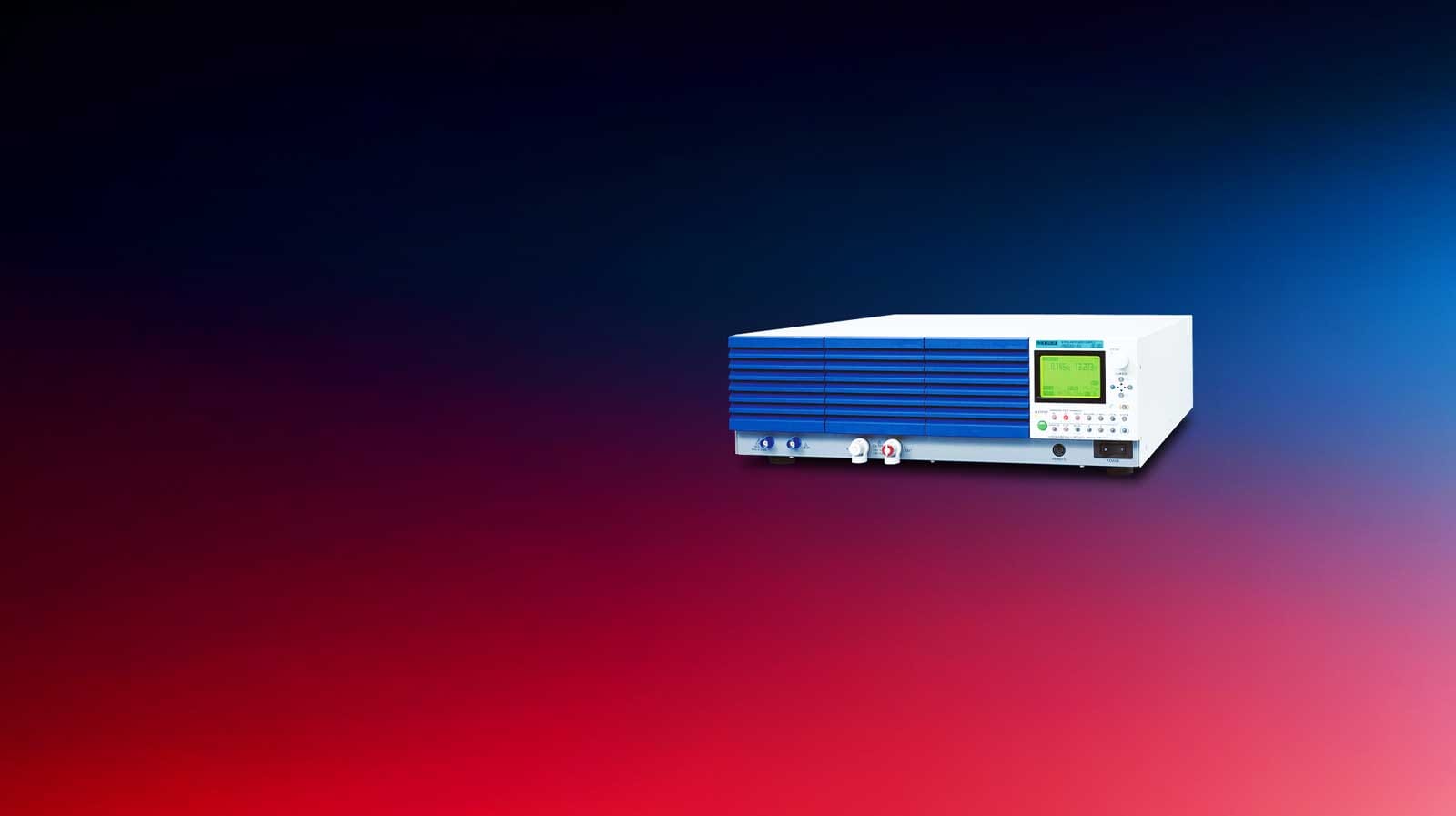
What Is 4-Quadrant Operation, How Linear Amplifiers Work, and How to Select the Right Model
(Kikusui PBZ Series, PBZ20-20A, PBZ-SR, PBZ-BP — Automotive Transients, Inductive Loads & Wireless Power)
Summary
- A Bipolar Power Supply is the only instrument that can simultaneously source and sink power at both positive and negative voltages — no mechanical switching, no dead zone.
- The Kikusui PBZ Series achieves DC–100 kHz bandwidth (PBZ20-20A: DC–150 kHz in CV mode) via a linear push-pull amplifier, enabling high-fidelity waveform simulation for EV, automotive, and magnetic applications.
- The PBZ20-20A is mandatory for ISO 7637 automotive compliance testing: it delivers ±120A peak current (6× rated) for cranking simulations, DC–150 kHz CV bandwidth, and a feedback loop tuned for high-capacitance ECU loads.
Introduction: What Is a Bipolar Power Supply?
A Bipolar Power Supply is defined as a programmable instrument capable of outputting both positive and negative voltages and currents without mechanical switching, enabling seamless 4-quadrant operation across the V-I plane.
In the rigorous world of power electronics, the roles of “source” and “sink” are traditionally fixed. A standard DC Power Supply is a Source that pushes energy, and an Electronic Load is a Sink that absorbs it. However, modern engineering challenges — from high-frequency ripple on EV battery lines to the violent transients of an automotive ignition cycle — demand an instrument that can switch roles in microseconds.
What happens when a motor acts as a generator during braking? What happens when an LC circuit oscillates, pushing current back into the power supply? A standard power supply would trip its Over Voltage Protection (OVP) and shut down.
The Bipolar Power Supply (also known as a 4-Quadrant Power Supply or High-Speed Power Amplifier) is the definitive solution to these challenges. Unlike a conventional DC supply limited to positive voltage and unidirectional current, a Bipolar Power Supply can freely output both positive and negative voltages and currents without switching terminals. It functions less like a battery and more like a High-Power Operational Amplifier, capable of amplifying complex waveforms from DC to 100 kHz (DC to 150 kHz on the PBZ20-20A) with high fidelity.
This guide serves as the ultimate technical resource for engineers, exploring the physics of 4-quadrant operation, the internal architecture of linear power amplifiers, and the critical distinction between Kikusui’s standard PBZ Series and the specialized automotive model, the PBZ20-20A.
Session 1: The Physics of Bipolar Power — Mastering the 4 Quadrants
In short: A Bipolar Power Supply operates in all four quadrants of the V-I plane, enabling it to both source and sink power with positive and negative polarity.
To understand the necessity of a Bipolar Supply, one must visualize the V-I (Voltage vs. Current) Plane. While standard DC sources live in a single corner of this plane, a Bipolar Supply masters all four.
1.1 Defining the Coordinate System and Energy Flow
- Quadrant 1 (Source / Forward): +V, +I. The supply acts as a conventional source, pushing current into a resistive or capacitive load. Energy flows from Supply → Load.
- Quadrant 2 (Sink / Reverse): +V, -I. The supply maintains a positive voltage but absorbs current coming back from the DUT. This is essentially an “Electronic Load” mode. Energy flows from Load → Supply (dissipated as heat).
- Quadrant 3 (Source / Reverse): -V, -I. The supply pushes energy with reversed polarity. Critical for driving bi-directional actuators or bipolar magnetic fields.
- Quadrant 4 (Sink / Forward): -V, +I. The supply absorbs energy while at a negative voltage.
1.2 The “Zero-Cross” Problem and Continuous Control
A standard DC supply cannot cross 0 V without using mechanical relays to swap polarity, which creates a “dead zone” or glitch in the waveform.
The Physics of Inductive Loads: When current (I) flows through an inductor (L), energy is stored in the magnetic field (E = 0.5 × L × I²). Inductance resists changes in current according to the formula: V = −L (di/dt). If a standard power supply tries to cross zero by opening a relay (instantaneous di/dt), the inductor generates a massive voltage spike (Back-EMF) to keep the current flowing. This spike can destroy the DUT or the power supply contacts.
The Bipolar Advantage: A Bipolar Power Supply crosses the 0 V point smoothly and linearly without any mechanical switching. It provides a continuous path for the current to flow, even as the voltage polarity reverses, allowing stored inductive energy to be safely absorbed (sunk) by the power supply.
Session 2: Architecture — Why Linear Amplification Matters for Bipolar Supplies
In short: The PBZ Series uses a push-pull linear amplifier — not a switching converter — to achieve microsecond-level response, full 4-quadrant operation, and 100 kHz bandwidth.
2.1 Push-Pull Linear Amplifier Stage
The PBZ Series utilizes a massive Push-Pull Linear Amplifier instead of a switching (PWM) converter.
- The “Push” Circuit: NPN power transistors drive positive current flow.
- The “Pull” Circuit: PNP power transistors (or active sink circuits) actively pull current from the DUT.
Thermal Management & Sink Capacity: Unlike standard switching supplies, a linear push-pull architecture must safely dissipate sunk energy as heat. To maximize testing flexibility without compromising reliability, the PBZ Series features a highly versatile dual-mode thermal architecture:
- Unipolar Mode: The system delivers a full 400 W of continuous sink capacity, allowing the unit to function as a robust, high-power electronic load for standard directional testing.
- Bipolar Mode: Designed for seamless, high-speed 4-quadrant operation across zero volts. In this highly dynamic state, the continuous sink power is precisely optimized to 100 W (for the PBZ20-20 and 20-20A) and 180 W (for the PBZ40-10).
This transparent power allocation allows engineers to confidently design continuous, complex test profiles with guaranteed thermal stability, ensuring high-fidelity waveform reproduction without the risk of unexpected thermal shutdown.
2.2 Bandwidth and Slew Rate (di/dt and dv/dt)
In many R&D scenarios, the PBZ acts as a High-Power Function Generator.
Frequency Response (100 kHz): Modern EV inverters switch at frequencies of 10 kHz to 100 kHz. To test the noise immunity of components connected to these lines, the power supply must be able to generate equivalent ripple. The PBZ Series supports DC to 100 kHz in CV mode (PBZ20-20A: DC to 150 kHz), allowing for realistic superimposition of switching noise onto a DC bias.
Slew Rate: Defines how fast the voltage can jump from, say, −10 V to +10 V. Kikusui’s PBZ series offers rise times in the microsecond range (100 V/μs for specific models), essential for simulating the sharp transients of the ISO 7637 automotive standard.
Session 3: Key Specifications Every Engineer Should Know
3.1 Variable Internal Resistance (R-int)
A real-world battery is not “ideal”; it has an internal resistance that causes voltage to sag under load.
- The Math: V(terminal) = V(internal) − I(load) × R(int)
- The Feature: The PBZ Series allows you to digitally program a Virtual Internal Resistance.
Why It Matters: When testing an ECU (Electronic Control Unit), engineers must simulate a “weak” or “discharged” battery. As the ECU draws current, the voltage should drop. The PBZ recreates this sag automatically based on the current draw, eliminating bulky, dangerous physical power resistors from the test setup.
3.2 Response Speed and Inductive Load Stability
Driving a large coil (e.g., for magnetic resonance or wireless power) causes a phase shift where current lags voltage. High-speed amplifiers often become unstable and oscillate under these conditions because the feedback loop cannot distinguish between the signal and the reactive kickback.
Stability Control: The PBZ allows engineers to manually adjust the response speed (CV/CC Loop Gain). By slowing down the amplifier’s internal feedback loop to match the load’s time constant, you can drive even highly inductive loads (like superconducting magnets) with perfect stability.
Session 4: Kikusui PBZ Lineup — Standard vs. Automotive Specialist
Kikusui offers a dual-approach to the 20V/20A range. Understanding the difference between the Standard Model (PBZ20-20) and the Specialized Model (PBZ20-20A) is critical for selecting the right tool.
Quick Comparison: PBZ20-20 vs. PBZ20-20A
| Feature | PBZ20-20 (Standard) | PBZ20-20A (Automotive) |
|---|---|---|
| Target Application | General R&D, Magnetics, WPT | Automotive Compliance (ISO 7637 / ISO 16750 / SAE J1113) |
| Voltage / Current (rated) | ±20 V / ±20 A (400 W) | ±20 V / ±20 A (400 W) |
| Peak Current (short-term) | ±20 A (1× rated) | ±120 A peak (6× rated) — mandatory for cranking tests |
| CV Bandwidth | DC–100 kHz | DC–150 kHz (wider = sharper pulse edges) |
| Capacitive Load Stability | Standard | Enhanced — tuned feedback loop |
| ISO Pulse Fidelity | General-purpose | High-fidelity (ISO 7637 pulse shapes) |
| Output Impedance Tuning | Standard | Tuned for cranking Pulse 4 and transients |
| Max Parallel Units | 5 units via PBZ-SR (±100 A) | 10 units standalone (±1,200 A peak) |
| Primary Use Case | Helmholtz coils, actuators, waveform gen | ECU validation, OEM compliance testing |
1. PBZ20-20 — The General-Purpose Standard
The versatile workhorse of the series, designed for broad R&D applications.
- Target: Magnetic Physics, General Electronics, Wireless Power Transfer (WPT).
- Specs: ±20 V / ±20 A (400 W).
- Optimized for general resistive and inductive loads (coils, motors).
- Why Choose Standard: Helmholtz coils, small actuators, general lab waveform generation.
2. PBZ20-20A — The “Automotive Spec” Evolution
The PBZ20-20A is a specialized variation re-engineered specifically for the extreme demands of Automotive Compliance Testing (ISO 7637-2, ISO 16750-2, SAE J1113).
Key differentiators vs. PBZ20-20 (Standard):
- ±120A Peak Current (6× Rated) — The primary automotive advantage. While the rated continuous output is ±20 A, the PBZ20-20A can deliver ±120 A for short durations. This is essential for ISO 7637 cranking simulation (Pulse 4), where the battery must supply an enormous instantaneous current to start the engine, causing the bus voltage to drop to 4 V or less. No standard bipolar supply can reproduce this pulse without this peak current headroom.
- DC–150 kHz CV Bandwidth (vs. 100 kHz on standard models): The wider bandwidth means steeper voltage edges and more faithful reproduction of the sharp transients defined in ISO 7637. Higher bandwidth = more accurate pulse shape.
- Capacitive Load Stability: Automotive ECUs typically have massive input capacitors for EMI filtering. Standard high-speed amplifiers often oscillate when connected to such large capacitance. The PBZ20-20A features a tuned feedback loop that remains stable even under these high-capacitance loads.
- Output Impedance Tuning: To strictly meet ISO waveforms (e.g., cranking Pulse 4), the supply’s output impedance must behave in a specific way during rapid transients. The “A” model is precisely tuned to reproduce these ISO pulses with higher fidelity.
- 10-Unit Parallel Standalone: Up to 10 PBZ20-20A units can be paralleled directly, achieving ±20 V / ±200 A continuous (±1,200 A peak) — without requiring the PBZ-SR rack system.
- Why Choose “A”: Mandatory for ISO 7637 compliance testing, complex automotive ECU validation, and any application requiring large short-term peak currents up to ±120 A.
3. High-Voltage Lineup (Standard PBZ)
| Model | Voltage / Current | Primary Application |
|---|---|---|
| PBZ40-10 | ±40 V / 10 A | 24V commercial vehicles, industrial robotics |
| PBZ60-6.7 | ±60 V / 6.7 A | 48V Mild-Hybrid (LV 148), telecommunications |
| PBZ80-5 | ±80 V / 5 A | Piezo-actuators, MEMS, high-impedance sensors |
4. PBZ-SR (Smart Rack) — Scaling Standard PBZ to Kilowatts
When 400 W is insufficient, the PBZ-SR system allows Master-Slave parallel connection of up to 5 standard PBZ units in a single rack chassis.
- Capability: A PBZ20-100SR (five PBZ20-20 units) provides ±20 V / ±100 A while maintaining the 100 kHz response time of the individual units.
- Note on PBZ20-20A: The PBZ20-20A does not require the SR rack for parallel operation — it supports up to 10 units in direct Master-Slave configuration, achieving ±20 V / ±200 A continuous (±1,200 A peak) independently.
- Why Needed: Mandatory for driving massive Helmholtz Coils in magnetic sensor calibration for ADAS systems, where high continuous current is required to generate strong, stable magnetic fields.
5. PBZ-BP Series — High-Power Integrated Bipolar System
The PBZ-BP Series is a purpose-built high-power bipolar supply platform, integrating multiple parallel units into a single intelligent system rather than requiring external master-slave wiring.
| Model | Voltage | Current (CC) | Key Specification |
|---|---|---|---|
| PBZ20-120 BP | ±20 V | ±120 A | 2,400 W — entry-level high-current bipolar |
| PBZ20-160 BP | ±20 V | ±160 A | 3,200 W — mid-range |
| PBZ20-200 BP | ±20 V | ±200 A | 4,000 W — maximum 20V configuration |
| PBZ40-60 BP | ±40 V | ±60 A | 2,400 W — for 24V vehicle bus testing |
| PBZ40-80 BP | ±40 V | ±80 A | 3,200 W — mid-range 40V |
| PBZ40-100 BP | ±40 V | ±100 A | 4,000 W — maximum 40V configuration |
Key Features of the PBZ-BP Series:
- High-Current Bipolar in a Single Unit: Delivers up to ±200 A (±20 V models) or ±100 A (±40 V models) in one integrated system — no separate rack controller required.
- CV Bandwidth: DC–80 kHz (slightly lower than the standard PBZ’s 100 kHz, optimized for the high-current output stage). Suitable for EV battery simulation, large actuator driving, and motor winding testing.
- Synchronized Master-Slave Operation: Up to 4 kW maximum output per the standard configuration; further expansion via master-slave parallel stacking.
- Full Interface Suite: LAN (LXI), USB, GPIB, and RS232C included as standard — no extra-cost options required.
- Advanced Waveform Functions: User-defined waveform generation, sequence function, and synchronized multi-unit operation for complex test profiles.
- Safety Architecture: If an alarm triggers on any one unit, all units are simultaneously shut off to protect the DUT. Clearing the master unit alarm resets the entire system.
- Best For: High-current EV battery simulation, large-coil magnetic field generation, motor and actuator winding testing, and any application needing bipolar operation above 20 A that exceeds what a single PBZ unit can provide.
Session 5: Application Scenarios & Real-World Validation
5.1 Automotive Surge & Cranking (ISO 16750 / ISO 7637)
The Challenge: During engine startup (Cranking / ISO 7637 Pulse 4), the battery voltage drops to 4 V or less in milliseconds while simultaneously delivering an enormous inrush current to the starter motor. A standard 20 A bipolar supply cannot reproduce this pulse — the peak current demand far exceeds its rating.
The Solution: The PBZ20-20A delivers ±120 A peak (6× rated), providing the short-duration current headroom required to faithfully reproduce ISO 7637 Pulse 4 (Engine Cranking) and the rigorous starting profiles of ISO 16750-2. Its 150 kHz CV bandwidth ensures the steep voltage edges perfectly match the fast transient timings specified in the standards.
Furthermore, when driving active or inductive automotive components (such as motors or solenoids), the 4-quadrant linear architecture seamlessly absorbs back-EMF and regenerative currents. This allows the PBZ20-20A to maintain absolute voltage stability and continue testing without tripping Over Voltage Protection (OVP) — a common failure point in standard unidirectional power supplies.
5.2 Electrolytic Capacitor Ripple Durability
The Challenge: Capacitors in EV inverters are constantly subject to high-frequency ripple current. To test their life expectancy, they must be stressed with high-frequency AC superimposed on a DC bias.
The Test: Set the PBZ to a 48 V DC bias and superimpose a 20 kHz to 100 kHz sine wave.
Why PBZ: Conventional testers use bulky LC circuits to protect the amplifier from DC. The PBZ’s 4-quadrant linear stage absorbs the negative half of the AC ripple directly (Sink mode), providing a pure, controlled stress on the capacitor without external blocking components.
5.3 Magnetic Field Control (Helmholtz Coils)
The Challenge: Calibrating high-precision Hall sensors requires a magnetic field that sweeps from North (+B) to South (−B) linearly.
The Outcome: The PBZ sweeps current from +I to −I through zero without a glitch or dead band. This ensures the magnetic field reverses with perfect linearity — essential for MRI research and high-precision compass calibration. The standard PBZ20-20 is often the preferred choice for this application.
5.4 Wireless Power Transfer (WPT) Coil Testing
The Challenge: Testing the primary coil of a wireless charger requires driving it with AC at specific frequencies (e.g., 85 kHz for EV wireless charging).
The Solution: The PBZ acts as a high-power variable frequency AC source. Its 100 kHz bandwidth covers the fundamental frequency of the Qi and SAE J2954 standards, allowing direct characterization of coil behavior under load.
Session 6: Selection Guide, Common Mistakes, and FAQ
How to Select a Bipolar Power Supply
- Analyze the Bandwidth: Do you need just DC polarity reversal, or 100 kHz ripple? The PBZ Series offers the highest bandwidth in its class.
- Determine your current requirements:
- 12V Automotive Compliance / ISO 7637 cranking → Choose PBZ20-20A (±120A peak, 150 kHz)
- General Lab / Magnetics / WPT → Choose PBZ20-20
- 24V / 48V Systems → Choose PBZ40-10 or PBZ60-6.7
- High-current (>20A), integrated system → Choose PBZ-BP (up to ±200A / ±20V)
- Check Reactive Power: If driving a purely capacitive load, the PBZ will sink power for half the cycle. Ensure your continuous “Sink” wattage does not exceed the unit’s thermal rating.
Common Mistakes to Avoid
Confusing Bipolar with Bidirectional:
| Bidirectional (PXB) | Bipolar (PBZ) | |
|---|---|---|
| Power Level | High (20 kW+) | Moderate (400 W) |
| Architecture | Switching (regenerative) | Linear |
| Response Speed | Slow (ms range) | Fast (μs range) |
| Negative Voltage | No | Yes |
| Best For | Battery charging / cycling | Waveform simulation, ripple, magnetic coils |
Cable Inductance: Long, untwisted cables will act as a low-pass filter, killing the 100 kHz bandwidth you paid for. Always use twisted-pair cabling or low-inductance busbars when testing at high frequencies.
FAQ for Engineers
Q: What is the difference between a bipolar power supply and a bidirectional power supply?
A: A bipolar power supply (e.g., PBZ) uses a linear amplifier architecture to achieve microsecond-level response and can output negative voltages. A bidirectional supply (e.g., PXB) is switching-based, highly efficient, but limited to positive voltage and slower transient response. Choose PBZ for waveform simulation; choose PXB for battery cycling.
Q: What frequency range does the Kikusui PBZ support?
A: The standard PBZ Series (PBZ20-20, PBZ40-10, etc.) supports DC to 100 kHz in CV mode. The PBZ20-20A extends this to DC to 150 kHz in CV mode, providing wider bandwidth for sharper pulse edges. Both ranges cover EV wireless charging (85 kHz per SAE J2954) and inverter switching noise. The PBZ-BP Series operates at DC to 80 kHz, optimized for its high-current output stage.
Q: Can I mix PBZ20-20 and PBZ20-20A in parallel?
A: It is generally recommended to use identical models for parallel operation to ensure perfectly balanced current sharing and transient response characteristics.
Q: Can I use the PBZ as a pure Electronic Load?
A: Yes. In Quadrants 2 and 4, it acts as a fully functional, high-speed electronic load that can sink current even at 0 V or negative voltages — unlike standard e-loads that require a minimum operating voltage.
Q: What software is required for ISO 7637 pulse generation?
A: The unit can be controlled via front panel or SCPI commands. For complex waveform creation (like ISO 7637 pulses), the optional Wavy for PBZ software is highly recommended for its graphical waveform programming interface.
Q: How does the PBZ handle capacitive loads without oscillation?
A: The PBZ20-20A features a specially tuned feedback loop designed to remain stable when connected to the large input capacitors typical of automotive ECUs. The standard PBZ20-20 uses a general-purpose loop that may exhibit ringing on high-capacitance loads, which is why the “A” model is mandatory for ECU compliance testing.
Q: What is the maximum parallel current available, and does it differ by model?
A: It depends on the model. (1) PBZ20-20 / Standard PBZ via PBZ-SR: Up to 5 units in a Smart Rack configuration → ±20 V / ±100 A (2,000 W). (2) PBZ20-20A standalone: Up to 10 units in direct Master-Slave parallel → ±20 V / ±200 A continuous, with a combined peak current capability of ±1,200 A for short-duration cranking simulations. (3) PBZ-BP Series: High-current system delivering up to ±200 A (±20 V models) or ±100 A (±40 V models) in a single integrated unit, with further expansion via parallel stacking.
Final Thoughts: The High-Speed Heart of the Lab
The Bipolar Power Supply is the only instrument that truly understands that the world is not always positive or steady-state. By acting as a Source, a Sink, and a Waveform Generator simultaneously, the Kikusui PBZ Series bridges the gap between signal integrity and power electronics.
Whether you are performing strict automotive compliance with the PBZ20-20A (±120 A peak, DC–150 kHz), scaling current with the PBZ-SR rack or the PBZ-BP integrated high-power platform, or driving advanced magnetic physics experiments with the standard PBZ20-20, Kikusui provides the high-speed edge required to turn complex power challenges into validated engineering solutions.
Kikusui PBZ Series | PBZ20-20A | PBZ-BP | PBZ-SR | Bipolar Power Supply | 4-Quadrant Operation | ISO 7637 Automotive Testing | Peak Current 120A | 150kHz Bandwidth | Linear Power Amplifier | High-Speed Waveform Generation | Inductive Load Testing | EV Component Testing

